
Wake up in the morning, brush your teeth, and open LinkedIn. Tell me, what do you see?
A stream of "groundbreaking" announcements, mind-blowing achievements. "Experts" who are absolutely "thrilled to share" their latest success. Apparently, we live in a world where everyone is a visionary, every startup is a unicorn, stocks are rising, the market is booming. Life is good!
But here's the thing: it's all of them but you.
You scroll faster. Everyone's climbing the promotion ladder, making money, building products. And you? You're drowning. Linear algebra, optimization, ML and deep learning, then LLMs and agent systems, MLOps and system design. Too much on your plate. Too many papers to keep up with. Too many people to catch up to.
You know what success looks like: a very smart guy who writes complex math in papers, fills dense appendices with Greek letters, and designs architecture diagrams that look like circuit boards. We've learned to recognize this shape. We see it and think: this must be real. Look how cool and useful it is! But let me ask you: are you sure this is what success looks like? How could you be sure?
It's not an easy question. You haven't lived that success; you've seen its showroom. So let me take you to an actual showroom: IKEA. You walk through staged rooms no one lives in, think, look how cool this is, then arrange your real home to match. The fake isn't a photoshopped image of a real room—it becomes the template for real rooms. The fake produces the reality!
That inversion creates a self-inflating balloon that keeps you up at night trying to catch a career that does not exist. And it is not only you—you suffer, companies suffer, and even the whole economy! But wait, I am not saying we are in a bubble. Bubbles pop and you return to normal. We're in a simulacrum—there's no normal to return to.
So now, let me tell you what a simulacrum is. Jean Baudrillard described how an image can stop representing reality and become the model reality is made to follow. Eventually, asking where the original went no longer gets you anywhere. His Simulacra and Simulation opens with this warning:
"The simulacrum is never that which conceals the truth—it is the truth which conceals that there is none. The simulacrum is true!"
Baudrillard's simulacrum is a very dangerous idea, and if you buy it, we will need to talk about it. But first, let me tell you how we got here.
Welcome to the Greatest Hallucination
Going from reality to simulation is not a new trick. Picture the old arrangement: people gather food and build houses. When trouble comes, they turn to the wise guys. The wise guys become important, acquire authority over the story, and start telling everyone how to live. Dogma becomes an institution. The hallucination becomes something real. It is not false information; it is the code people live by.
The simulation validates and amplifies itself. It rewards narrators, not value builders. It is not the farmers or workers who came to power, but the priests and kings. It is not the workers who make money, but the guys who run the bank. And so on.
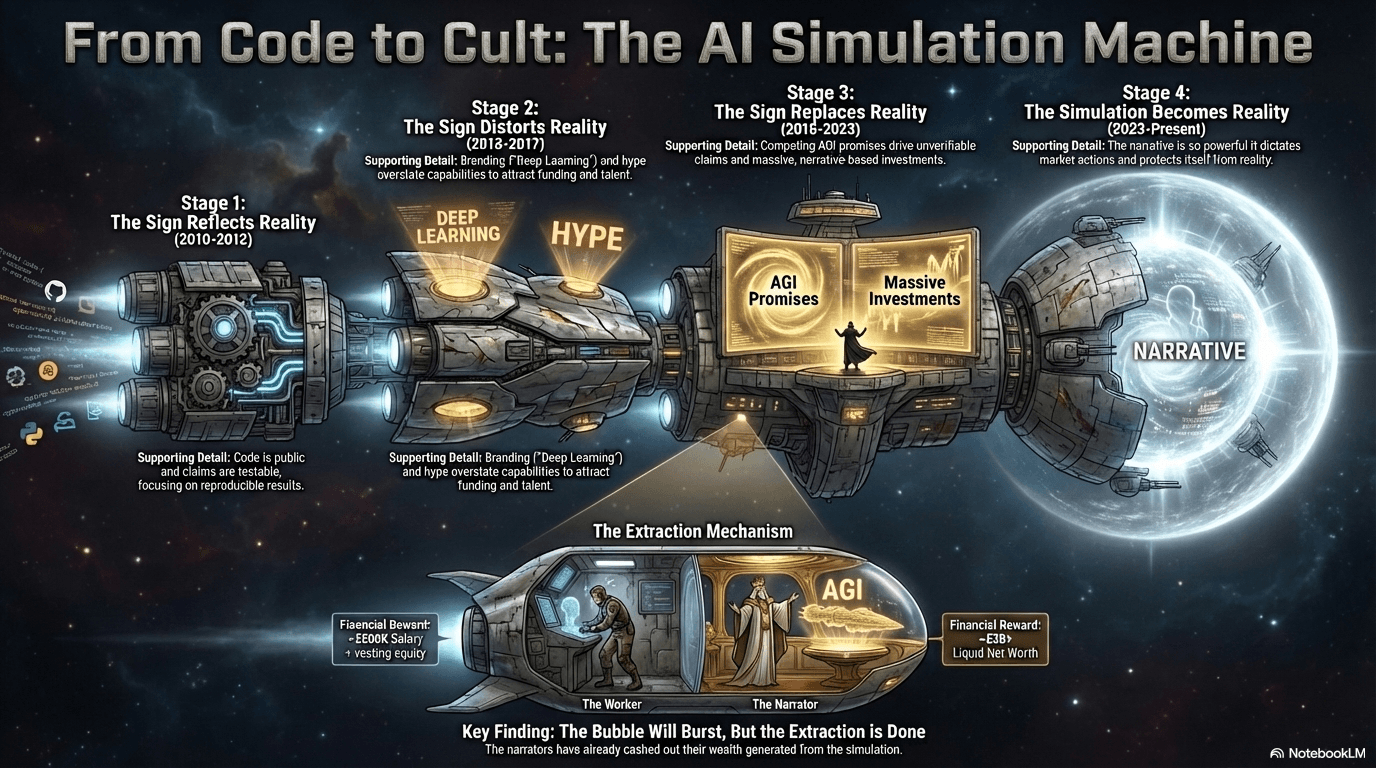
But who cares about the past? We are in the AI age now—the simulation on fast-forward, haha. We did not need centuries. In roughly fifteen years, the story went from useful models to a whole reality organized around them.
Brief History of the Great Hallucination
The stages overlap. What changes is which one sets the terms.
Stage 1: The Sign Reflects Reality (2008-2012)
ML became hot. People realized it was a very useful tool. Andrew Ng's 2011 online course attracts more than 100,000 students. AlexNet crushes ImageNet in 2012. You can download code, run experiments, argue over results. Knowledge leads to results. Results lead to reward.
Then the break: too many ML graduates, too much venture capital. Everyone needs a new story.
Stage 2: The Sign Distorts Reality (2013-2023)
Ten years of gradual hype buildup. The shift wasn't a button press—it was slow drift.
DeepMind's DQN learns to play Atari games. AlphaGo beats Lee Sedol and the world loses its mind. Neural machine translation takes over Google Translate. Real breakthroughs—but the hype machine kicks in.
"Deep Learning" becomes the name everyone wants on the cover. Neural networks acquire depth, compute—and much better branding. You test 47 architectures, report the winner, and let the other 46 rest in peace. Every startup adds "AI-powered" to its deck. Elon keeps promising full self-driving. IBM Watson goes from Jeopardy to oncology. Self-driving is "99% solved"—except the last 1% is the entire problem.
GPT-2 arrives surrounded by warnings about misuse. The largest version is withheld, then released that November. Whatever the intention, "too dangerous to release" is quite a product launch. GPT-3 arrives at a scale most researchers cannot afford to train, with weights they cannot download. Papers cite papers cite capabilities their readers cannot independently check.
ML is eating the world. In 2014, Parallel Double Greedy Submodular Maximization appears at NIPS: approximation guarantees, parallelism, concurrency control. Familiar computer-science questions, gathered under an ML roof. The umbrella now covers the algorithms, the optimization, and the systems underneath. By the time all of that reaches the company deck, the whole stack is an AI achievement.
The sign still points to something. Just not as much as claimed.
Stage 3: The Sign Masks Absence (2022-2024)
November 2022: ChatGPT launches. Within two months, an estimated 100 million monthly active users. AI stops being a niche topic and becomes the only topic.
The multibillion-dollar commitments pile up. By early 2025, the reported figures include:
- Microsoft → OpenAI: at least $13B committed
- Google → Anthropic: more than $3B committed
- Amazon → Anthropic: $8B
What are they buying? More than current capabilities—those are commoditizing. They're buying territory in the AGI market. The market that doesn't exist yet. The market everyone agrees will exist because everyone is buying territory in it.
Stage 4: Full Simulacrum (By 2025)
By now, the simulation is validating itself. Look at the episodes that brought us here.
The simulation protects its narrators: November 2023—OpenAI's board fires Sam Altman. Employees threaten to leave en masse. Microsoft offers a landing place. Within days, a deal brings Sam back; a new initial board follows. The people with the formal authority to remove him cannot make the removal stick. The narrator turns out to be harder to replace than the board.
October 2024—Hinton and Hopfield win the Physics Nobel for work that used ideas from physics to build learning networks. Hassabis and Jumper share the Chemistry Nobel for protein-structure prediction, alongside David Baker for protein design. Watch what happens to the story: distinct scientific achievements become one industry-wide victory. AI won physics! AI won chemistry! The ultimate gatekeepers of scientific legitimacy become part of the AI victory lap. The prize is specific; the borrowed authority travels everywhere.
January 2025—Stargate announces plans for $500B in AI infrastructure over four years. Half a trillion dollars. The number is so absurd it glitches. But a number that large must mean something real is happening. The scale proves the substance. Which justifies more investment. Which proves AGI is near.
The godfather still has work to do: November 2025—Yann LeCun, Turing Award winner and one of the three "Godfathers of Deep Learning," announces plans to leave Meta to build a company around his Advanced Machine Intelligence research program. Meta will remain a partner. World understanding, persistent memory, planning: listen to the list. These are the things the sales pitch lets us assume are already on their way. A godfather is building a research program to get there. We borrow his authority to announce the destination, then stop listening when he describes how much road remains.
It's turtles all the way down:
Nvidia sells real chips. But investors are also pricing in a future in which demand keeps growing. Those expectations lean on OpenAI's growth story. That story leans on Microsoft's backing. Microsoft's backing leans on Azure compute growth. Azure compute growth leans on... startups buying compute with VC money to build AI products, while investors point at Nvidia's success as proof that the whole thing works.
Follow the justification around the loop and where do you end up? Back at the expectations you started with. A self-referential loop of expectations inflating expectations.
The simulation bootstraps its own reality!
The Nature of the Simulacrum
Before you go looking for the architect—some shadowy cabal pulling strings—let me save you time: there aren't any. Nobody designed this. The Matrix wasn't built by machines. It emerged from us.
Fear of exclusion. Need for status. Looking at the group to work out where it's safe to stand. Now these instincts drive us to chase metrics we don't believe in and signal belonging to tribes we don't respect.
The system optimizes for its own metrics—valuations, engagement, citations—which drift further from anything that matters. Take a simplified example: Big Tech Giant invests 500 million here is an illustration.
The market values Sign Value—hype, prestige, the appearance of innovation—over Use Value—does this solve a boring problem profitably? That gap is where the system eats itself.
Why can't anyone escape?
In a simulacrum, awareness doesn't break the spell—it's part of the spell. Workers are trapped by hope ("If I build good tech, I'll become successful"), belief ("We really are building AGI"), and golden handcuffs (equity vesting, resume building, sunk cost). Narrators are trapped by competition (other narrators will out-simulate you) and lock-in (admitting simulation destroys valuation). Both are trapped. The system runs on everyone's participation.
The Glitches
You know the feeling. Déjà vu. The story stutters. Something doesn't fit.
We still die from cancer. We still live in small apartments. We still sit in traffic. Poverty is still there. COVID pushed us to the limit. Then you open LinkedIn and discover we've already entered a new civilization. Apparently nobody told the landlord.
Meanwhile:
- Valuations price in customers who haven't arrived
- "Experts" multiply but problems don't get solved
- Investor-funded spending comes back dressed as independent demand
- Everyone is "thriving" but everyone is burned out
- Productivity tools proliferate but nobody has more time
- The most valuable companies sell picks and shovels for a gold rush that may never come
The narrative says revolution. Reality says: same problems, shinier dashboards.
And here's the really fucked up part: we see the glitches. We scroll past "thrilled to share" with a smirk. We joke about the grifters. We roll our eyes at the complexity theater. We're all aware the emperor has no clothes.
And we keep playing. We refresh portfolios. We network at conferences. We update LinkedIn with carefully crafted humility. We half-hope our company gets acquired before anyone checks whether the metrics are real.
Because in a simulacrum, awareness doesn't break the spell—it's part of the spell. Cynical distance is how we tolerate our participation. We know it's bullshit. We do it anyway. The performance continues because everyone is performing, and no one wants to be the first to stop. The simulation runs on our participation.
The Inevitable Collapse
So we like the game—why should we care? Couldn't the simulation run forever?
Fortunately or unfortunately, depending on your taste, the answer is no. Simulations need fuel. This one keeps borrowing it from the future.
Economic Concentration
The AI boom was driven by economic incentive. Now more and more of the growth story depends on the same bet: AI will justify the money pouring into it. The cloud providers, the chipmakers, the model labs—different names, increasingly dependent on the same promised future.
But here's the problem with the next doubling: expectations can double on a screen. Paying demand has to come from somewhere. Customers need budgets. Data centers need power, chips, land. Healthcare, logistics, food, housing—the physical world keeps sending invoices while we finance its replacement.
Now suppose a lab misses its revenue target. It needs more funding to keep buying compute. If that funding stops, it cuts its cloud spending. The cloud provider loses part of the growth that helped justify the investment in the first place. What looked like separate confirmations—funding, cloud revenue, rising valuations—turns out to depend on the same customer's next round. The loop can run backwards. A better story cannot pay the electricity bill forever.
The Automation Paradox
AI promises automation and cost savings. Translation: massive job displacement. The pitch deck says "efficiency." The spreadsheet says "layoffs."
But here's the paradox nobody wants to talk about: if the savings flow to owners while workers lose their income, automation erodes the customer base. If AI replaces workers, who pays for AI? The product starts eating the market it was supposed to serve.
You can't automate your way to prosperity if prosperity requires customers with jobs.
The Breakthrough on the Roadmap
Tons of papers. Tons of conferences. Tons of PhDs. But where are the breakthroughs?
It feels like technology building, not research. Same architectures, more parameters, bigger datasets. We plot GPT-2, GPT-3, and GPT-4 on a slide, extend the line, and budget for the next point. But that missing point is a research problem. You can approve a bigger training run; you cannot approve the discovery it is supposed to produce.
What happens when the next leap takes longer than the funding cycle? The research problem gets a deadline, and the researcher gets a performance review.
The Structural Inevitability
Here's the really uncomfortable truth: every simulation eventually collides with something it can't simulate.
The AI simulation will collide with economics (financing and paying demand), society (the automation paradox), and science (research on a funding deadline).
These pressures meet in the same business plan. It needs capable systems, customers who can pay, and returns big enough to finance the next leap. The narrator can promise all three together; the company has to make them work together. That's where the loop runs into trouble. The models don't have to stop improving for the financial story to break. A useful product can survive and still earn far less than the business built around it needs.
When that collision comes—and it will—the question isn't whether there's a correction. It's how severe.
The Reload
When the simulation breaks, the hype vanishes. But the value stays. The infrastructure stays.
Electricity had its prophets and exhibitions and wild promises. Now it powers everything quietly. The internet had its dot-com crash. What survived? Email, e-commerce, search—tools that actually work.
AI will follow the same path. Not AGI prophecy. Not robot apocalypse. Just tools that solve specific problems. Exciting, useful, grounded.
And here's the beautiful part: what emerges is often more impactful than what was promised. The real revolution happens after the hype dies.
But don't get too comfortable. Every reload plants the seeds of the next simulation. The cycle continues. New technology, new prophets, new promises.
Surviving Simulacra
Here's where The Matrix got it wrong. There's no red pill. There's no blue pill. Take both.
Live in the simulation. Think outside of it. You can't exit—you have bills, a career, a life inside. But you can learn to surf it.
Open source erodes narrator value. Narrators control access, gatekeep knowledge, hide behind mystery. Open source puts more capability in other people's hands. When code and model weights are available, more people can test, compete, improve. Llama didn't just challenge GPT—it broke the mystique. Hugging Face didn't just host models—it spread the ability to build. The narrators lose power when the magic becomes reproducible.
Democracy of infrastructure. Don't rent your capabilities from the narrators. Local compute, open models, community-owned tools. The more decentralized the infrastructure, the less leverage the simulation has over you. Build on foundations you can verify, not promises you have to trust. A data center doesn't change owners because a valuation collapses. If we want the builders to inherit anything, we have to build that independence before the crash.
Build real value. Use Value over Sign Value. Solve problems customers actually pay for—without VC subsidies propping up the illusion. Your customer needs the thing to work, not another quarterly explanation of why it doesn't. When the reload comes, the things that actually work survive. The things that only exist as performance don't.
Surf the glitches. Train your eye for contradictions—that's where opportunity lives. Valuations running ahead of customers. Expertise without output. Investment passing for demand. When the story stops making sense, that's your signal. The collapse opens a fight over who gets to build what comes next. The narrators lose their grip; the builders have a chance to take control of the infrastructure. Having that chance and taking it are two different things.
You can't exit the simulation. But you can learn to surf it.
Related Posts
When Thought Became Electric — Part I: The Question
Before the computer was built, there was an older dream: to write down reason itself. Three collisions between that dream and the modern machine — from Saussure and word2vec, to Wittgenstein and hallucination, to Hume and generalization.
Agent Autonomy - Part 2: Going Beyond Algorithms
How can agents improve educational demos when quality depends on human judgment? A proposed workflow using explicit teaching patterns, multiple evaluators, and checks on what those evaluations actually measure.
The Love-Prompt of Devesh the Octopus
Devesh ran a shady octopus meat caravan in the Simulation. Top agent, deep cover. Eight tentacles, eight side hustles. A story about love, AI, and taxes.